For those in higher education who struggle with adult learning theory and how to make course content relevant and engaging to their students, differentiated instruction could be the answer.
As adults, we expect courses to meet us where we are. Curricula that embrace rote memorization, a “one-size-fits-all” mentality, neglect learner choice, and provide little to no life relevancy hold little interest for adult learners, however, many higher education courses exhibit these very practices (Dosch & Zidon, 2014; Hauptman, 2015).
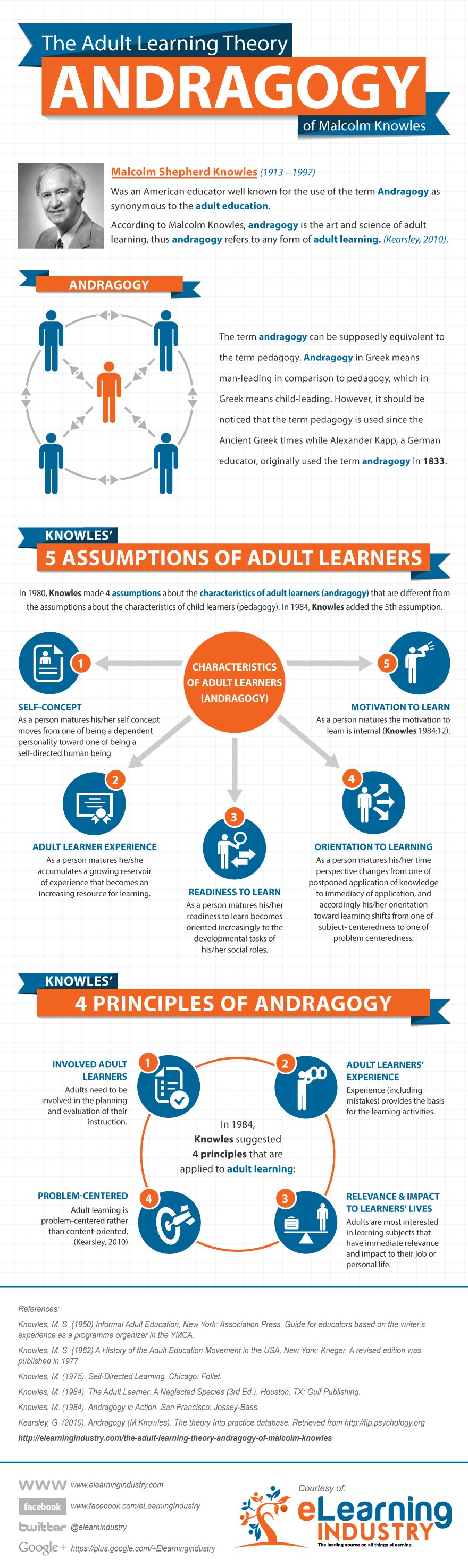
In The Adult Learner: A Neglected Species, Malcolm Knowles (1984) described five basic assumptions that characterize adult learning, or andragogy. According to Knowles (1984)*, as adults:
- We see ourselves as independent, self-directed individuals.
- We have a variety of life experiences we reference to understand the content with which we engage during learning.
- Our readiness to learn is increasingly related to our social and professional roles.
- We want to see the immediate application of the learning (and its benefit) to our lives.
- We are internally motivated to learn.
(*See image below for more information about Knowles’ Theory of Andragogy)
Arguments against andragogy aside, as instructors, we are tasked with the design of educational experiences, creating opportunities for student learning that, ideally, “meet the learning needs of all students, not just a subset” (Rutter, 2016). The theory of differentiated instruction provides a solid framework for how we implement this practice. Focusing on modifications across content, process, product, and affect/environment, faculty can provide students the opportunity to choose and create meaningful learning experiences, while still meeting course objectives (TEAL, 2010; Rutter, 2016; Hauptman, 2015; Dosch & Zidon, 2014).
Studies which examine the use of differentiation in adult learning report benefits to students, including:
- Instructor has more holistic understanding of students (Dosch & Zidon, 2014)
- Students experience freedom of choice and engagement; deeper learning (Dosch & Zidon, 2014; McCarty, Crow, Mims, Potthoff, & Harvey, 2016)
- Learning is authentic to student’s life and needs (Huang, 2002)
- Learning is high-quality and learner-centered (Huang, 2002)
- Teamwork accounts for “individual learning objectives, preferences, and capabilities” (Huang, 2002, p. 32)
- Groups allow for peer mentoring and peer-to-peer learning as teams work to solve relevant problems (TEAL, 2010; Rutter, 2016)
Little surprise, really, when compared to the characteristics of adult learning as described by Knowles (1984) over 30 years ago. Differentiation respects adults as self-directed, internally-motivated individuals who bring their experience to the table in learning environments as they seek real world application and relevance in the content with which they engage.
A conversation of benefits, however, would not be complete without a realistic examination of the challenges to implementing differentiation in the higher education classroom. Dosch & Zidon (2014) cite large classes, limited contact hours, the extensive time required to create multiple assessment methods, and perceived fairness in grading as reasons for the limited research available on differentiation in higher education. McCarty et al. (2016) further explains that students perceive a lack of fairness when different essays are assigned to different students based on perceived readiness. In a time when the term “arbitrary and capricious” can haunt a professor’s tenure and career, these are very real concerns. While the research does not directly address these issues, and further research is required, it would seem, as in any situation where faculty are being asked to implement new strategies, proper support, training, and an administration that embraces a paradigm shift across the campus are necessary for widespread success of the change.
Regardless of the challenges to implementation, we should never forget that “differentiating the process and product for students [honors] their diversity as learners and [creates] motivation to learn” (Hauptman, 2015).
Citations
Dosch, M. & Zidon, M. (2014). “The course fit us”: Differentiated instruction in the college classroom. Educational Journal of Teaching and Learning in Higher Education, 26(3), 343-357. Retrieved from http://files.eric.ed.gov/fulltext/EJ1060829.pdf
Hauptman, A. (2015, April 10). Differentiation for the adult learner. Lipscomb Education Connection. Retrieved from http://www.lipscomb.edu/education/blog/education/2015/4/10/differentiation-for-adult-learners
Huang, H. (2002). Toward constructivism for adult learners in online learning environments. British Journal of Educational Technology, 33(1), 27-27. Retrieved from https://brainmass.com/file/1433703/Article.pdf
Knowles, M. (1984). The adult learner: A neglected species (3rd ed.). Houston, TX: Gulf Publishing.
McCarty, W., Crow, S., Mims, G., Potthoff, D., & Harvey, J. (2016). Renewing teaching practices: Differentiated instruction in the college classroom. Journal of Curriculum, Teaching, Learning and Leadership in Education, 1(1), 35-44. Retrieved from http://digitalcommons.unomaha.edu/ctlle/vol1/iss1/5
Rutter, M.P. (2016, May 4). Differentiated instruction in the college classroom: Multiple forms of learning in the same classroom. Inside Higher Ed. Retrieved from https://www.insidehighered.com/blogs/higher-ed-beta/differentiated-instruction-college-classroom
Teaching Excellence in Adult Literacy (TEAL) Center Staff. (2010). Differentiated instruction. TEAL Center Fact Sheet No. 5. Retrieved from https://lincs.ed.gov/sites/default/files/5_TEAL_Differentiated_Instruct.pdf

Heather,
Great points about how we automatically think that the curriculum for adult classes should be relevant to our current day. I am often of the opinion that the information should be useful and interesting. We don’t want classes to be a waste of our time, to be blunt. I agree that we, as adults, are motivated to learn for different reasons than children.
Josie
I think this is such a fascinating dynamic, Josie. As a teacher, I watched my peers presenting professional development model the opposite of the active learning strategies they were asking us to implement. As an employee in higher ed, I hear my peers complain about mandatory meetings or development events, noting how bored/insulted they are to just sit and listen as someone “talks at them,” yet I watch them lecture for 90 minutes, never stopping to ask a question. As a student, I abhor anything that wastes my time, but I’m not always as respectful of my students’ time and lives as I should be. Mea culpa.
As adults, we’ve finally been given the ability to ask the questions we want to ask, chase the rabbits we want to chase (figuratively…although maybe literally for some), and do the things we want to do. We realize, as we age and take on more responsibilities, what the term “precious little time” really means. So we balk (and sometimes grow quite mutinous) when we feel our time is being wasted in pursuits that are not our own.
Yet, it seems, much as the education trainers who do not model their own best practices and strategies, we sometimes forget our very nature, that which makes us “adult,” when we design content, courses, or interactions for our students. While there’s no one solution, I find it helpful to ask myself if I would enjoy the activity, want to do the work, have time to complete the content, need more explanation, etc. when I’m building course activities. I use the mid-semester and end-of-course anonymous evaluations my students to complete to get a feel for where they are; if they’re not happy, I make immediate changes, if possible. For example, students commented that they felt a bit lost in the big picture of the course, so I now have a big picture video at the beginning so they know why they’re being asked to do what they’re being asked to do. I also have added and subtracted content, or included choice, based on their feedback. I think it’s just a matter of being cognizant that we’re educating adults who don’t really “have to” (as K-12 students do) and making sure we make the experience meaningful.
It is interesting to read about adult learners and how they can be different than K-12. I assume you are referring to post secondary students, and might be referring to middle-aged adults taking courses. All this discussion about differentiation and how it can be applied in classes, I wonder if there is such a thing as differentiation in College Algebra, Trigonometry, Pre-calculus, or even Calculus? How does that look like in a university setting? Are they teaching any different than when I went to college in the 80s? I didn’t use technology in any of my math classes. In fact, the only time I used a computer is when I took Computer Science courses, for programming, or running software. I hear current college math students use graphing calculators, but I have no idea to what extent. I suppose I was taught “classical mathematics”, and not “applied mathematics”. I was helping a high school senior yesterday decide what they needed to do to prepare themselves for an Applied Calculus class they are taking in the fall. From the description of the course, they learn the basics of calculus (differentiation, and integration) but the emphasis is on real-world applications to solve problems using calculus. The prerequisite for this course was College Algebra. That was not how I was taught! It would be nice to know how mathematics education is throughout the grades, from kindergarten to college senior. I feel isolated many times because of my “ignorance”. 🙂
In my College Algebra course, we were allowed to use graphic calculators and didn’t have to show our work. I thought it was, frankly, kind of a joke after taking Calculus my Senior year. That said, I’m not sure what math looks like today – I’ve not been in a math class since 1999. Have you ever thought about working with UA professors and hosting an informal round table or peer event wherein you can discuss how math is being taught in Higher Ed? Even if you can’t modify your curriculum, it would give you an idea of how concepts are being applied and where your students are going.
As far as differentiation, for content knowledge acquisition could be a choice between their textbook, a Khan Academy video, or a prerecorded lecture from you. Process could include the option to do the learning individually or with peers, learning stations where each included a different type of problem to solve or problem-based team learning activities. Product could be an assessment, a peer teach, etc. If you aren’t sure where to start, I would encourage you to set up a coffee date (or happy hour) “think tank” with your coworkers and just brainstorm what it might look like and where you might start. Even if you don’t arrive at any solutions, it will give you fodder for later.
In review of Knowles principles of Andragogy I have taken some time to ponder how it applies to classes I have taken or observed (1984). Nursing is my main learning focus. I have not been able to discover ways that we involve our students in the planning of instruction. I see how we integrate self evaluation to the process however do we really help the students understand the process of self-reflection as it applies to self-evaluation. Often I see students (and staff when I was a manager) frustrated with self-reflection especially when it relates to evaluation with an “authority figure”. I wonder if it is fear, poor self-esteem or possibly lack of understanding of how to perform the process.
Knowles also discusses adult motivation for self learning of information that impacts ones life and has relevance. In nursing we often use the case studies to make information relevant however use of more relevant current cases,topics of change, news, current research to show more relevant importance of information and how it applies. Learning about differentiation and learning processes I implemented the idea to assign one topic per week of skills for students to find an article of their choice, less than 5 years old, and share what they learned from what they read with the group. The rational was that the students would take a personal interest in the topic and research it from thier chosen angle of meaningful thought. The topics assigned part of the regulated curriculum for the nursing in skills lab. We have conducted discussion groups for the past 3 weeks where the students presented on the various topic. This has improved student interaction/discussion on current topics, interest in nursing research, and relevant personal desire for knowledge.
Knowles, M. (1984). Andragogy in Action. Sanfransisco: Jossey-Bass.
I think this is a great way to engage students with the content and allow them to find something that interests them and relates to what they are studying!
To your point on reflection, I’m coming to the realization that it’s a skill that needs to be taught. In many ways, deep introspection seems to be a thing of the past. When you ask students (and sometimes people in general) for reflection, you are likely to receive a very surface level account of events and perhaps, if you are lucky, what they did well or not; rarely do they discuss the personal biases that may have influenced or motivations behind their decisions, how these choices impacted events further down the road, what they have learned from the process, and how it will change their behavior moving forward. Facing flaws, describing strengths, growing in the process, and then reporting on progress takes deeply personal reflection…and we are a society of surface level interaction.
On spot! The word reflection is often interpreted as superficial. I wonder…do we have a generation who are so consumed by superficial advertising, social media/networking, and such that they may not understand how to reflect on any deeper level because life does not require it of them? Not enough time to have silence (although some process better in noise) to face fears, concerns, life challenges? I am sure it does not apply to the masses however could it be generalized to a generational issue? Do those with less exposure to these things find themselves more introspective, evaluators’ of feelings and how they affect them? I must say I am challenged by this and intrigued by it as well. If you know of any tools to help students become more introspective I would appreciate the lead.
I, too, wonder if the immediate and surface nature of contact afforded by social media plays a roll or if it’s a generational trend towards a less introspective existence. I’m not sure these are questions we can answer, but they’re definitely ones I’ve been pondering for a while. I do happen to have a rubric we created for a reflection in one of our courses that describes a good reflection. They don’t do so well on the pre-reflection, because they aren’t used to it, but the post-reflections have been quite insightful. I’ll send it to you!